 tsumo
tsumoCan I play Mahjong online for free on this site?
Yes. You can start a browser game without downloading a desktop app. Begin with a tutorial if the tiles or turn flow are unfamiliar, then use a bot game to practice at your own pace.
Read categorized Mahjong FAQ answers for beginners: getting started, mode choice, scoring confusion, online behavior, improvement planning, and account/privacy support.
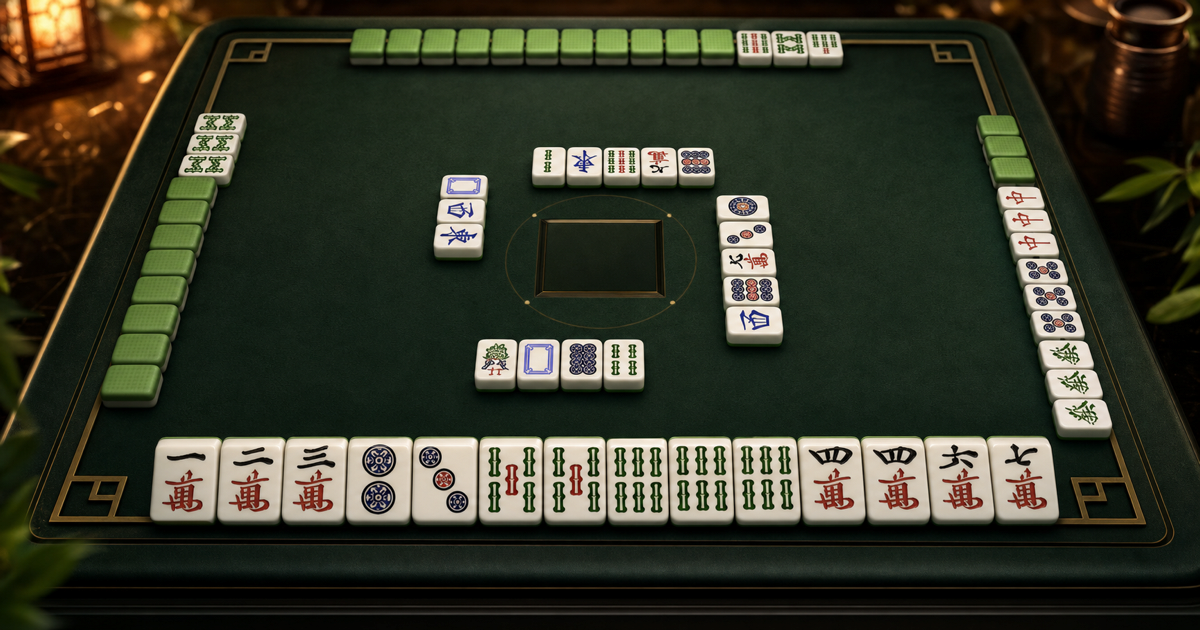
Use these answers before your first table session. They establish the free browser experience, the recommended beginner mode, and the difference between learning flow and memorizing scoring.
Yes. You can start a browser game without downloading a desktop app. Begin with a tutorial if the tiles or turn flow are unfamiliar, then use a bot game to practice at your own pace.
Start with How to Play Mahjong, then choose the Simplified Chinese tutorial for a low-overhead first hand. Once drawing, discarding, groups, and pairs feel familiar, compare the six modes before committing to a ruleset.
Many players can understand the draw-discard loop and standard winning shape in one focused session. Playing confidently takes longer because claims, scoring, and defensive choices vary by ruleset. Learn one decision layer at a time.
No. Learn turn flow, tile groups, and the winning shape first. Before playing a scored mode, remember only its legality gate—for example, one yaku in Riichi or 8 non-flower points in MCR—then expand your scoring knowledge gradually.
Bots are useful for learning controls and pausing to inspect a decision. Move to multiplayer when you can complete a hand, recognize legal claims, and explain your main discard choice. There is no required number of bot games.
Normal play moves counter-clockwise: after a discard, the player on the discarder’s right takes the next turn. A legal winning or meld claim can interrupt that order, so always let the claim window resolve first.
Use these answers when you are deciding whether to stay in the beginner path or move into a specialized ruleset. The goal is to pick one mode deliberately instead of switching whenever a scoring rule feels unfamiliar.
Simplified Chinese is the clearest starting point when you want to learn structure without a scoring gate. It is not universally best: choose HKOS for traditional value planning, or a family’s local rules when you are learning to join that table.
Move when the ordinary draw-discard rhythm, four-groups-plus-pair structure, and claim direction no longer consume all your attention. HKOS then adds a useful next lesson: planning enough non-flower faan before the hand is complete.
Riichi often has more up-front rules overhead because yaku, Furiten, Riichi declarations, and defensive clues interact. Some players still find its structured yaku list easier than HKOS table variation. Choose based on the group you want to play with and the decisions you enjoy.
MCR suits players who enjoy combining named patterns and tracking an explicit 8-point threshold. It can be a first ruleset, but expect to consult the pattern reference frequently while learning instead of memorizing the full scoring catalog at once.
You can compare all six immediately, but play one mode long enough to stabilize its tile handling, win gate, and action labels. Switching too quickly can blur important differences such as flowers, standard 14-tile wins versus 16-tile hand structures, and scoring eligibility.
Mahjong is a family of related games rather than one universal rules document. Regional traditions, tournaments, clubs, and apps select different scoring schedules and house rules. Each tsumo rulebook identifies the app profile so you can compare it with the table you plan to join.
Use these answers when a hand looks complete but the app rejects the win. They separate universal hand shape from variant-specific gates such as yaku, faan, and MCR points.
A complete shape is only the first check in several modes. Riichi needs a yaku, HKOS needs 3 non-flower faan in tsumo, MCR needs 8 non-flower points, and Taiwanese needs at least 1 tai. Open the matching rules guide to identify the missing condition.
First confirm that the hand has a yaku; dora alone is not enough. Then check Furiten. Discard Furiten, temporary Furiten after passing a legal Ron, and Riichi Furiten can all block Ron even though Tsumo may remain legal.
The app requires at least 8 non-flower points before flower bonuses. Count only compatible scoring patterns toward that gate and apply exclusions correctly. If the subtotal is below 8, the hand is not eligible unless it meets the exact Chicken Hand conditions.
tsumo’s HKOS profile requires at least 3 non-flower faan. Flowers can add value to the result but do not satisfy that minimum. Recheck the hand’s wind, dragon, suit, triplet, and concealed-hand patterns before declaring.
No. Dora, red fives, and ura dora add han only after the hand already has a valid yaku. Identify the yaku first—such as Riichi, Tanyao, or Yakuhai—then count bonus value.
Chicken Hand is a specific 8-point MCR pattern for a legal hand that has no other non-flower scoring pattern. It is not a general shortcut for hands worth 1–7 points, so verify its exact conditions before relying on it.
Simplified Chinese, HKOS, Riichi, and MCR normally hold 13 playable tiles between turns and win when a 14th completes four groups plus one pair. Filipino and Taiwanese are called 16-tile modes because players hold 16 between turns; a 17th tile completes five groups plus one pair. Replacement tiles and quads can temporarily change the physical count.
Use these answers when claim timing, priority, or tutorial behavior feels surprising. They explain why a legal claim can interrupt the normal counter-clockwise turn order.
A sequence claim is directional. You may claim the previous player’s discard—the player sitting to your left—because you are next in normal counter-clockwise turn order. Triplet, quad, and winning claims use different eligibility and priority rules.
Winning claims outrank ordinary meld claims. When more than one player can win, the result depends on the selected ruleset: some profiles allow multiple winners, while others award the discard to the nearest eligible player in turn order.
Tutorials are designed around the same mode contracts and action flow as live play. If a tutorial and a current game disagree, treat the live rules engine as authoritative and report the exact mode, hand, and action so the tutorial can be corrected.
The hand ends in an exhaustive draw. Dealer continuation, score transfers, and ready-hand payments depend on the mode and match profile, so check the relevant rulebook rather than assuming every draw resolves identically.
A Riichi declaration commits the hand. Non-winning draws are normally discarded without changing the hand, with only limited legal Kan exceptions. That loss of flexibility is the price of the declaration and its scoring opportunities.
Flowers are excluded in Simplified Chinese and Riichi, replaced for bonuses in HKOS and MCR, and treated differently in the two 16-tile modes. Filipino replaces honors as flowers in tsumo; Taiwanese keeps Winds and Dragons meldable and replaces only Flowers and Seasons.
These are app action labels for the same two broad outcomes: winning from another player’s discard or winning on your own draw. The label changes by mode so it matches the terminology used in that ruleset.
Not always. Each rules page describes the app profile and lists its reference sources. For example, tsumo’s ranked Riichi settings differ from WRC 2025 in red fives, starting points, Riichi restrictions, and simultaneous discard-win handling.
Use these answers after a few games, when the question changes from what the rules mean to how to improve decisions consistently across sessions.
Choose one decision that changed the hand and classify it as shape, value, claim, or defense. Write one correction you can recognize next time. A focused review is more useful than replaying every draw without a question.
Pick one mode, complete its tutorial, and alternate short bot sessions with one focused drill. Review the same decision category for several games before changing topics. Consistency matters more than reaching an arbitrary game count.
Defend when an opponent shows credible danger and your hand is slow, low-value, or waiting poorly. The exact clues differ by ruleset, but late turns and public declarations should raise the evidence required before you continue pushing.
Use the same short check every turn: identify your current win route, list the tiles that improve it, and compare the safest discard candidates. Under pressure, a repeatable checklist is more reliable than searching for a perfect move.
There is no universal sequence. Start with the ruleset you can practice regularly. If you have no table preference, Simplified Chinese teaches structure efficiently; after that, choose HKOS, Riichi, MCR, Filipino, or Taiwanese based on the scoring and hand style you want to learn.
Use these answers for support, privacy, accessibility, and cookie-control questions rather than gameplay strategy.
Use the Contact Us page or email support@tsumo.io. Include the page, ruleset, device, browser or app version, and what you expected to happen so the team can reproduce account, accessibility, or gameplay issues.
Review the Privacy Policy and Data Privacy and Rights pages for collection details and request options. Use the documented request channel so the team can verify identity before accessing, correcting, or deleting account data.
Open Cookie settings from the Cookie Policy or consent controls. You can change optional analytics or advertising choices without disabling cookies that are necessary for security, authentication, and core site operation.
Use Contact Us or email support@tsumo.io. Include the affected page, device, browser, assistive technology, and the task you could not complete. Specific reproduction details make accessibility issues easier to prioritize and verify.
Start with Simplified Chinese rules, run one tutorial, then play 5 bot games before entering online queue.
Shape is not enough in every mode. HKOS requires 3 non-flower faan, Riichi requires yaku, MCR requires 8 non-flower points, and Filipino/Taiwanese hands use larger mode-specific structures.
Memorize turn flow and claim legality first. Add scoring layers only after your discard decisions become stable.